

Endurance Pre-Workouts: Science Behind the Formulas
Endurance pre-workouts are specifically designed to support stamina, delay fatigue, and maintain focus during prolonged physical activities like running, cycling, and swimming. Unlike traditional pre-workouts, these formulas prioritize hydration, oxygen delivery, and acid buffering to meet the unique demands of endurance athletes. Key ingredients include:
- Caffeine: Improves focus, reduces perceived effort, and delays fatigue.
- Beta-Alanine: Buffers muscle acid buildup, extending time-to-exhaustion.
- L-Citrulline: Enhances blood flow and speeds up recovery.
- Electrolytes: Maintain hydration and prevent cramping during long workouts.
- Carbohydrates: Support sustained energy by replenishing glycogen stores.
Studies have shown that these supplements can improve endurance performance by up to 20% and reduce muscle soreness by 40%. Proper timing (30–60 minutes pre-exercise) and dosages are critical for maximizing benefits. However, long-term safety and effects on diverse populations remain under-researched.
For athletes seeking a reliable option, products like NutriFitt's KROBAA Pre-Workout combine clinically supported dosages with transparency, offering ingredients like 6,000 mg of L-Citrulline Malate and 3,200 mg of Beta-Alanine. These formulations are tailored for endurance, focusing on both physical and mental performance.
Key Ingredients and How They Work
Endurance pre-workouts are built around a select group of scientifically backed ingredients. Each one targets specific challenges that limit performance, focusing on stamina, recovery, and mental sharpness. These choices aren't random - they're grounded in research and designed to deliver measurable results.
Caffeine: Boosting Focus and Delaying Fatigue
Caffeine is the most studied performance enhancer in sports nutrition, and for good reason. By blocking adenosine receptors in the brain, it reduces the perception of effort and delays fatigue. Studies show caffeine can improve time-to-exhaustion performance by 24.2% and enhance time-trial results by 3.1% - impressive gains for athletes. Both anhydrous caffeine and regular coffee provide these benefits.
The ideal dose is 3–8.1 mg per kilogram of body weight (about 1.36–3.68 mg per pound). For a 150-pound individual, that’s around 204–552 mg, taken 45 to 60 minutes before a workout to ensure peak absorption. Beyond physical benefits, caffeine also lowers your Rating of Perceived Effort (RPE), making tough efforts feel more manageable - a game-changer during the final stretch of a long run or ride.
While caffeine sharpens mental focus and fights fatigue, beta-alanine steps in to help muscles perform better under intense conditions.
Beta-Alanine: Fighting Muscle Fatigue
Beta-alanine serves as a precursor to carnosine, a compound that buffers acid buildup in muscles. During high-intensity efforts, hydrogen ions accumulate, lowering pH and causing that burning sensation in your muscles. Carnosine neutralizes these ions, delaying fatigue and helping you push harder for longer.
A 2018 study published in the Journal of the International Society of Sports Nutrition found that taking 2.4 grams of beta-alanine daily for 28 days extended cycling time-to-exhaustion from 11.1 to 14.6 minutes - a 24% increase. Beyond physical endurance, beta-alanine also preserved cognitive function during exercise, as measured by the Stroop test, while the placebo group saw a decline in mental speed. Over 12 weeks, a daily dose of 3.2 grams increased muscle carnosine levels by 85.4%.
"By acting as a pH buffer, carnosine allows for larger accumulation of lactate during exercise by delaying the associated acidification of systemic pH known to have negative effects on exercise performance and cognition." - Furst, T., et al., Journal of the International Society of Sports Nutrition
For best results, take 3.2 to 6.4 grams daily for 4 to 6 weeks. Split the dose into smaller portions (about 800 mg each) and take with meals to avoid paresthesia, a harmless tingling sensation some people experience.
While beta-alanine works inside your muscles, L-citrulline operates on a systemic level to improve blood flow and recovery.
L-Citrulline: Enhancing Blood Flow and Recovery
L-citrulline converts into L-arginine, which boosts nitric oxide production and expands blood vessels. This process, called vasodilation, improves oxygen and nutrient delivery to muscles while speeding up waste removal. Unlike L-arginine, which loses about 40% of its effectiveness due to breakdown in the gut and liver, L-citrulline bypasses this degradation, making it far more efficient.
The benefits are clear. In one study of 41 men, taking 8 grams of citrulline malate reduced muscle soreness by 40% at 24 hours and 41% at 48 hours post-exercise. Another trial showed that L-citrulline supplementation increased total work output during performance tests (125 kJ compared to 123 kJ for the placebo).
"L-Citrulline supplementation has been a topic of debate due to its potential to augment L-arginine bioavailability and nitric oxide production." - J. Schierbauer, Division of Exercise Physiology and Metabolism, University of Bayreuth
Dosage: Take 6 to 8 grams of L-citrulline or citrulline malate 60 to 90 minutes before exercise to align with peak plasma arginine levels.
Carbohydrates and Electrolytes: Sustaining Energy and Hydration
Endurance workouts deplete glycogen stores and lead to significant fluid and electrolyte losses through sweat. Fast-acting carbohydrates, like cyclic dextrin, help maintain blood glucose levels, delaying the point where your body starts breaking down muscle for energy. Electrolytes - especially sodium and potassium, often sourced from Pink Himalayan Salt - are vital for balancing fluid levels, supporting muscle contractions, and preventing cramping during long sessions.
With L-citrulline improving blood flow, beta-alanine buffering acid buildup, and electrolytes stabilizing hydration, these ingredients work together to keep you performing at your best, recovering faster, and staying mentally sharp throughout your workout.
sbb-itb-7567710
What Clinical Studies Show About Performance
Study Results and Performance Measurements
Research into multi-ingredient pre-workout supplements (MIPS) has shown clear improvements in endurance and performance. For example, a study conducted in June 2020 by the Federal University of Piauí, Brazil, focused on 12 physically active men performing high-intensity intermittent exercise (HIIE). This double-blind, placebo-controlled trial revealed that taking MIPS one hour before exercise increased the number of 15-second running efforts at 120% of maximal aerobic speed from 36 to 41. Additionally, time to exhaustion improved from 17 minutes to 20.1 minutes - an 18.2% increase.
The same study noted significant boosts in energy system performance. Oxidative energy contribution rose by 23.8%, and ATP-CP contribution increased by 28.4%.
"Acute MIPS ingestion appears effective at increasing both aerobic and anaerobic alactic energy contribution and time to exhaustion during a HIIE protocol." - Journal of the International Society of Sports Nutrition
Beyond endurance, MIPS can also enhance physical responsiveness. A 2012 study published in Nutrition & Metabolism demonstrated a 5% improvement in choice reaction time for multi-directional movements (from 1.13 seconds to 1.07 seconds). Additionally, participants saw an increase in leg press muscular endurance at 75% of their 1-rep max (1-RM), going from 11 repetitions to 13 repetitions.
| Performance Metric | Placebo Group | MIPS Group | Improvement |
|---|---|---|---|
| Number of Efforts (HIIE) | 36 ± 12 | 41 ± 10 | ~13.8% |
| Time to Exhaustion | 17 ± 5 min | 20.1 ± 6 min | ~18.2% |
| Oxidative Energy Contribution | Baseline | +23.8% | 23.8% |
| ATP-CP Contribution | Baseline | +28.4% | 28.4% |
| Leg Press Repetitions (75% 1-RM) | 11 reps | 13 reps | ~18% |
These results highlight the measurable benefits of endurance-focused supplements, providing a foundation for products designed to improve athletic performance.
NutriFitt's KROBAA Pre-Workout: A Science-Based Formula
Building on these findings, NutriFitt developed KROBAA Pre-Workout to provide athletes with proven benefits. This formula includes clinically effective doses, such as 6,000 mg of L-Citrulline Malate to enhance blood flow and muscle pumps, 3,200 mg of Beta-Alanine to delay fatigue, and a 311 mg caffeine blend (Anhydrous, Citrate, and Infinergy™) for sustained energy. These dosages align with the levels shown to be effective in clinical research, giving endurance athletes both physical and mental support.
What makes KROBAA stand out is its focus on both performance and cognitive function. The formula includes patented nootropic ingredients like CognatiQ® and Sabroxy®, which boost brain-derived neurotrophic factor (BDNF). This helps athletes maintain focus and the mind-muscle connection, even during long or grueling training sessions when mental fatigue typically sets in.
Priced at $47.99 per container, KROBAA has received a 5.0/5-star rating from 8 customer reviews. Users describe it as their "daily driver", praising its ability to provide a strong energy boost and help tackle tough workouts. With its transparent ingredient list and research-backed dosages, KROBAA offers a practical option for athletes looking for reliable results without the guesswork.
How Endurance Pre-Workouts Differ from Strength Pre-Workouts
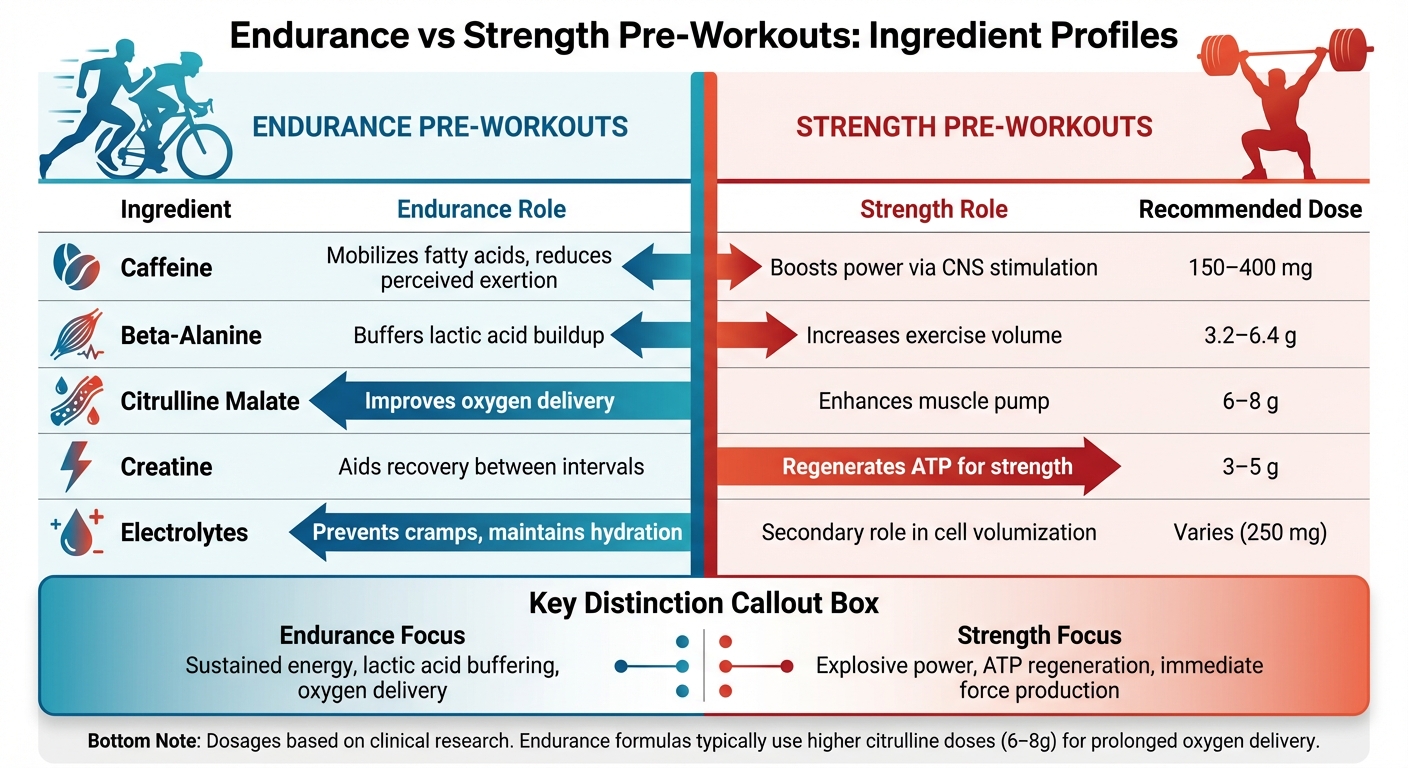
Endurance vs Strength Pre-Workout Ingredients Comparison
Ingredient Profiles: Different Formulas for Different Goals
Endurance and strength pre-workouts are designed with distinct goals in mind, which is why their ingredient profiles vary so much. Endurance products focus on keeping fatigue at bay and providing steady energy, while strength-focused formulas aim to deliver explosive power and quick energy regeneration.
Take caffeine, for example. In endurance pre-workouts, caffeine helps release fatty acids from fat stores, which conserves glycogen for the later stages of a workout. For strength athletes, caffeine's primary role is to stimulate the central nervous system, which boosts immediate power output. Similarly, beta-alanine works to buffer lactic acid for endurance athletes, helping them sustain high-intensity efforts over time. For strength training, it allows athletes to handle more overall exercise volume. Another key player, citrulline malate, supports oxygen delivery in endurance workouts but is prized in strength pre-workouts for producing that sought-after "muscle pump".
| Ingredient | Endurance Role | Strength Role | Dose |
|---|---|---|---|
| Caffeine | Mobilizes fatty acids, reduces exertion | Boosts power via CNS stimulation | 150–400 mg |
| Beta-Alanine | Buffers lactic acid | Increases exercise volume | 3.2–6.4 g |
| Citrulline Malate | Improves oxygen delivery | Enhances muscle pump | 6–8 g |
| Creatine | Aids recovery between intervals | Regenerates ATP for strength | 3–5 g |
| Electrolytes | Prevents cramps, maintains hydration | Secondary role in cell volumization | Varies (e.g., 250 mg Pink Salt) |
Electrolytes are another standout feature in endurance pre-workouts, as they’re essential for hydration and preventing cramps during long sessions. Endurance blends also tend to use higher doses of citrulline (6–8 g) since sustained oxygen delivery is critical for prolonged activity.
These ingredient choices reflect the distinct demands of endurance and strength athletes, ensuring each formula supports the specific energy and recovery needs of its target audience.
Physical Demands: Endurance vs. Strength Training
The physical challenges of endurance and strength training differ significantly, and so do the supplements designed to support them. Endurance activities often lead to a buildup of hydrogen ions and lactic acid, which can limit performance during long sessions. To counteract this, endurance pre-workouts focus on lactic acid buffering with ingredients like beta-alanine and taurine. Strength training, on the other hand, relies on the ATP-CP system for short bursts of explosive power, making creatine a key ingredient for rapid ATP regeneration.
Endurance athletes also face a higher risk of muscle breakdown during prolonged activity. To combat this, endurance formulas often include ingredients like HMB and L-glutamine, which help protect muscles from breaking down. Strength athletes, who typically perform shorter, high-intensity sets, focus on ingredients that enhance force production and immediate power.
How to Use Endurance Pre-Workouts and Research Gaps
When and How to Take Pre-Workouts
Timing and dosage are key when it comes to getting the most out of endurance pre-workouts. For most athletes, taking the supplement 30 to 60 minutes before exercise is ideal, allowing the active ingredients to reach their peak in the bloodstream. For runners and cyclists, a slightly shorter window - around 30–45 minutes before starting - is often better. This timing helps boost energy levels gradually without leading to jitters.
Different ingredients in pre-workouts peak at varying times. For example:
- Caffeine: Peaks in 45–60 minutes.
- Nitric oxide boosters: Take about 60–90 minutes.
- Ketones: Act quickly, within 10–15 minutes.
To start, try half a scoop to test your tolerance to stimulants. Mix one serving with 7–10 ounces of water and ensure you stay hydrated to counteract any dehydrating effects of stimulants.
Avoid using stimulant-based pre-workouts within 6 hours of bedtime to prevent sleep disruptions. If late workouts are part of your routine, consider switching to a stimulant-free option. For those with sensitive stomachs, pairing the pre-workout with a light carbohydrate snack - like a banana - can help. To prevent building a tolerance, it’s best to limit pre-workout use to 4–5 times per week.
What Current Research Doesn't Tell Us
Even with the right timing and dosage, there are still gaps in what we know about endurance pre-workouts. Most studies focus on short-term use (less than eight weeks), leaving us in the dark about the long-term effects of regular, multi-year consumption.
"MIPS ingestion appears to be relatively safe, though most studies that have assessed the safety of MIPS are relatively short (less than eight weeks) and thus more information is needed regarding the safety of long-term supplementation."
– Journal of the International Society of Sports Nutrition
Another issue is the prevalence of proprietary blends - about 44.3% of ingredients in pre-workouts fall into this category, where exact dosages aren’t disclosed. This makes it hard to pinpoint which ingredients are delivering the performance benefits. Additionally, many studies don’t include a caffeine-only control group, so it’s unclear if the results come from the combination of ingredients or just the caffeine.
Research also tends to focus on a very narrow demographic: young, healthy, resistance-trained males aged 18–35. There’s limited data on how these supplements affect women, older adults, adolescents, or people with conditions like cardiovascular disease. Finally, while many studies measure physiological changes - like VO2 max improvements or mitochondrial adaptations - few connect these to actual performance outcomes, such as marathon completion times.
| Research Gap | What's Missing | Why It Matters |
|---|---|---|
| Duration | Most studies are <12 weeks | Long-term safety and tolerance remain unclear |
| Demographics | Focus on young, active males | Limited data on women, elderly, and others |
| Formulation | Proprietary blends hide dosages | Hard to identify which ingredients drive results |
| Mechanisms | Unclear if benefits are just caffeine | Can't isolate the value of multi-ingredient formulas |
Filling these research gaps is essential for better understanding and improving endurance pre-workout strategies.
Conclusion: Using Science to Improve Endurance Performance
Endurance pre-workouts with scientifically studied ingredients can enhance performance by improving focus, reducing muscle fatigue, and increasing blood flow. Key components like caffeine (to lower perceived effort), beta-alanine (to buffer muscle acid), and citrulline malate (to boost blood flow) have been shown to deliver measurable benefits when taken in research-backed amounts. For instance, a double-blind study from January 2024 revealed that participants using a multi-ingredient pre-workout completed more repetitions (96.90 vs. 89.50) and experienced a lower rate of perceived exertion (7.6 vs. 8.3 RPE) compared to those using a placebo.
Clear labeling is essential when choosing supplements. Avoid products with "proprietary blends" that obscure ingredient dosages. Transparency ensures you know exactly what you're consuming and how it can help you.
"Every product we develop is formulated using real science to ensure the highest quality and effectiveness available." – NutriFitt
NutriFitt stands out with its KROBAA Pre-Workout, offering full transparency and precise, research-backed dosages. The formula includes 6,000 mg of L-Citrulline Malate, 3,200 mg of Beta-Alanine, and a 311 mg caffeine matrix. This detailed labeling empowers athletes to make informed choices and understand how each ingredient supports their performance goals.
Although more long-term studies are needed, current research supports the use of science-based pre-workouts to improve endurance. Opt for products with clear ingredient lists and clinically supported dosages to take your performance to the next level.
FAQs
How do I know if an endurance pre-workout is dosed effectively?
When evaluating an endurance pre-workout, pay attention to the dosages of key ingredients backed by research. For energy, look for 150-300 mg of caffeine. To help reduce muscle fatigue, aim for 2-5 g of beta-alanine, and for better blood flow and endurance, check for 6-8 g of citrulline malate. It's also important to choose products with transparent labels that clearly display the amounts of each ingredient, so you know exactly what you're getting.
Can I take endurance pre-workout on an empty stomach?
Yes, you can take endurance pre-workout on an empty stomach, but how your body reacts depends on your tolerance and the formula of the supplement. Some research indicates that working out in a fasted state might boost fat burning. On the other hand, eating before exercise could help enhance performance for some people. Pay attention to how your body responds and adjust your routine to what feels best for you during workouts.
Who should avoid stimulant-based endurance pre-workouts?
People who are sensitive to caffeine, have heart conditions, or are prone to anxiety should avoid stimulant-based endurance pre-workouts. These products can trigger or worsen symptoms such as jitteriness, a racing heart, or heightened nervousness, making them a poor choice for certain individuals.
Latest Posts
How Ashwagandha Supports Testosterone Levels
10 Best Natural Pre-Workout Ingredients
Best Electrolyte Supplements for Fitness Goals

Best Nootropics for Productivity in 2026

Top 5 Sleep Hygiene Practices for Athletes

5 Best Pre-Workouts for Pump

The 30-Minute Body That Beats the 2-Hour One
Short, high-intensity 30-minute workouts can deliver equal or better cardio, strength, and fat-loss results than long sessions.
Checklist for Choosing Clean Label Certified Supplements
Checklist to verify certifications, ingredient transparency, batch COAs, GMP compliance, and bioavailable forms in clean-label supplements.