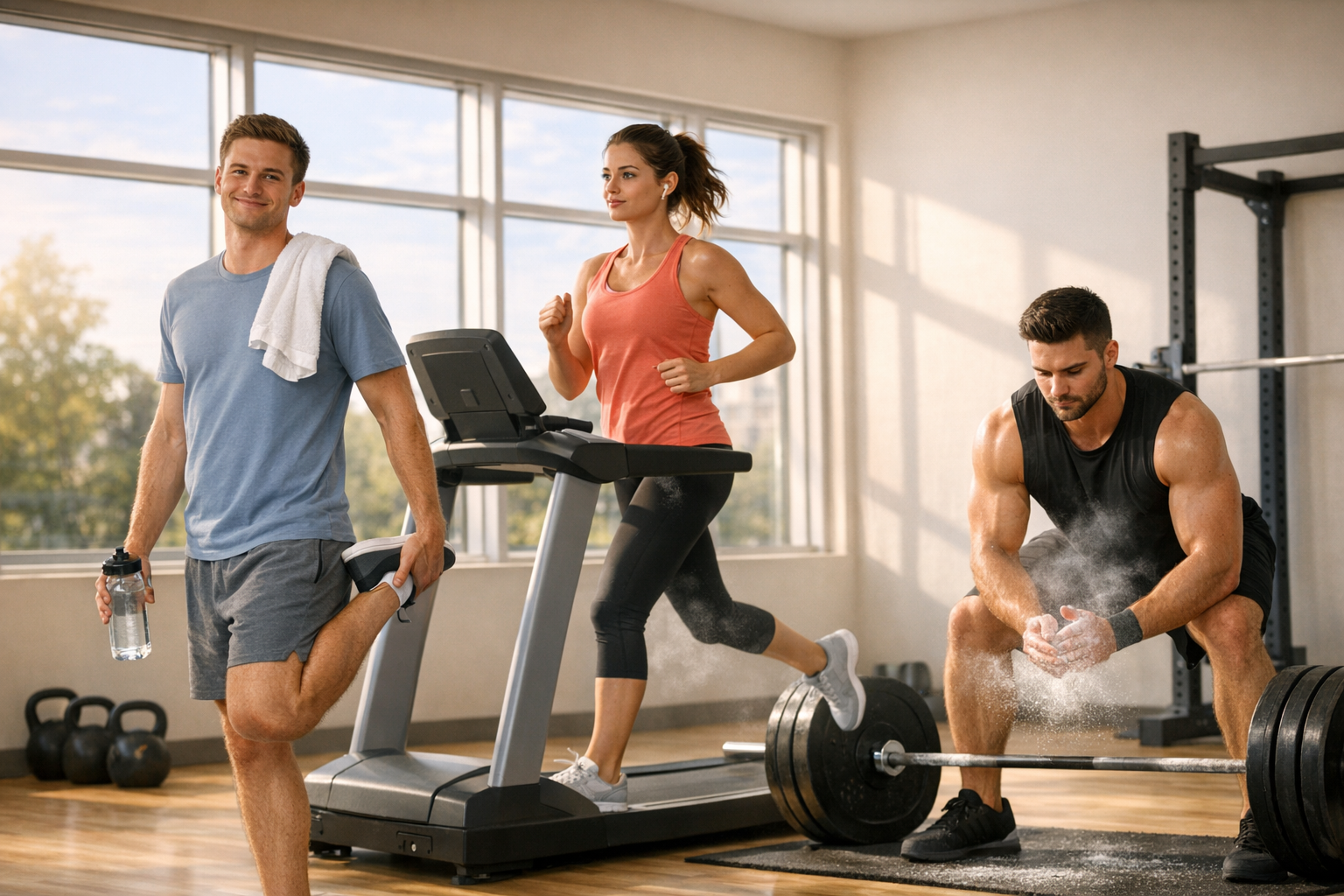








5 Ways To Measure Workout Intensity
Here's how you can measure it:
- Heart Rate Monitoring: Use your heart rate to stay in the right zone (50%-85% of your max heart rate). Wearables make it easy, or go manual with a quick pulse check.
- Rate of Perceived Exertion (RPE): Rate how hard you're working on a scale of 1-10 based on how you feel. No tools needed.
- Talk Test: Can you speak comfortably? If not, you're likely in a higher intensity zone.
- Percentage of Max Effort: Push to a specific percentage of your max heart rate or lifting capacity for precise tracking.
- Wearable Technology: Smartwatches and fitness trackers offer real-time data for heart rate, calories, and more.
Each method offers a way to manage effort and avoid overtraining. Combine these techniques to find what works best for your fitness goals.
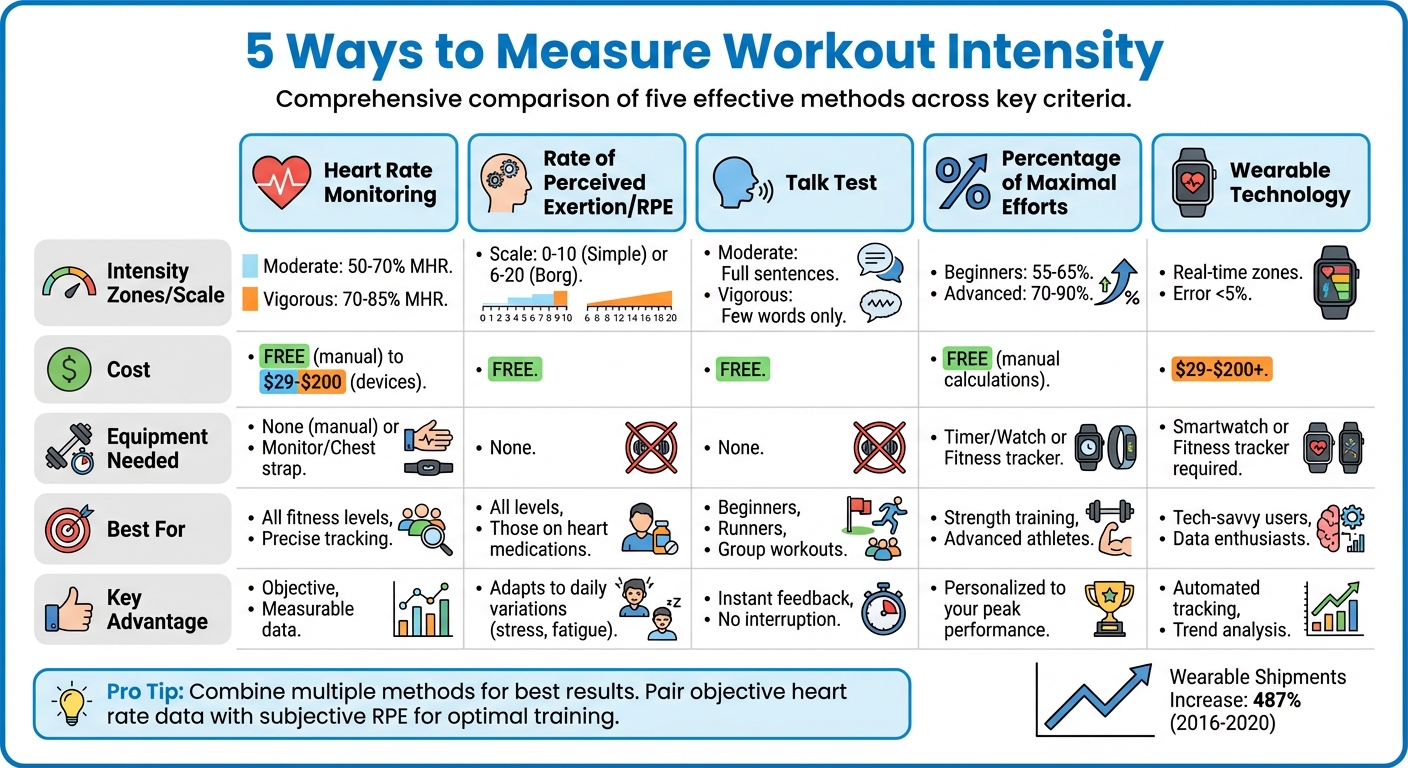
5 Methods to Measure Workout Intensity: Comparison Guide
1. Heart Rate Monitoring
Tracking your heart rate gives you clear, measurable insights into how hard your body is working during exercise. Unlike relying on how you feel, heart rate data provides solid numbers. The basic idea is simple: the harder you push yourself, the higher your heart rate climbs.
Accuracy of Measurement
To measure exercise intensity effectively, compare your heart rate to your Maximum Heart Rate (MHR) - the highest rate your heart can safely handle during activity. You can estimate your MHR with the formula: 208 – (age × 0.7). For example, a 30-year-old would have an approximate MHR of 187 beats per minute (bpm). For a more tailored approach, the Heart Rate Reserve (HRR) method factors in your resting heart rate.
Moderate exercise typically falls within 50% to 70% of your MHR, while vigorous activity ranges between 70% and 85%. However, these numbers can vary by 15 to 20 bpm based on your fitness level and health.
It’s worth noting that certain medications, like beta-blockers used for high blood pressure, can lower your heart rate. This might make standard heart rate zones less accurate for you. If this applies, you may need to adjust your target zones or explore other ways to measure intensity.
These guidelines provide a solid foundation for monitoring your heart rate and applying it effectively.
Ease of Use
You don’t need fancy equipment to check your heart rate manually. Just place two fingers on your carotid artery (neck) or radial artery (wrist), count the beats for 15 seconds, and multiply by four. The downside? You’ll need to briefly pause your workout.
Wearable devices, on the other hand, let you monitor your heart rate in real time without interruptions. Consumer Reports tested 11 heart-rate monitors and found all of them to be highly accurate compared to a doctor’s electrocardiograph (EKG). Chest strap monitors tend to be the most precise but require a snug fit and sometimes need to be moistened to work properly. Wrist-based monitors are more convenient, but they also need to fit snugly for reliable results.
Suitability for Different Fitness Levels
Heart rate monitoring works for everyone, no matter where you are on your fitness journey. The key is how you use the data. If you’re just getting started, aim for the lower end of your target zone - around 50% of your MHR - and gradually increase intensity over time. Dr. Ed Laskowski of Mayo Clinic Sports Medicine suggests increasing your activity by about 10% per week to ensure safe progress.
"Well, we want that target heart rate range. And that means we're working hard enough that our heart is getting beneficial activity and beneficial exercise." – Dr. Ed Laskowski, Co-director of Mayo Clinic Sports Medicine
For seasoned athletes, heart rate data can be combined with other metrics like power output or perceived exertion to fine-tune training. If you’re over 45 (for men) or 55 (for women), it’s a good idea to check with your doctor before diving into a high-intensity program.
By aligning your method with your fitness level, you can monitor intensity safely and effectively.
Cost and Accessibility
Heart rate monitoring doesn’t have to break the bank. Manual pulse checks are completely free and require only a timer or watch. Wearable devices, while more convenient, come in a range of prices to fit different budgets.
| Monitor Type | Cost Range | Key Consideration |
|---|---|---|
| Manual Pulse Check | Free | Requires pausing briefly |
| Touch-Type Wristwatch | $29–$100 | Affordable entry-level option |
| Chest Strap | $50–$150 | High accuracy |
| Continuous Wristwatch | $100–$200 | Real-time tracking |
Whether you prefer a simple manual check or a high-tech wearable, there’s an option to suit your needs and budget. The choice comes down to whether you prioritize precise data or feel comfortable relying on your body’s natural signals.
sbb-itb-7567710
2. Rate of Perceived Exertion (RPE)
Rate of Perceived Exertion (RPE) measures how intense a workout feels based on your own physical sensations. Instead of depending on gadgets or numerical data, you tune into signals like your breathing, heart rate, sweat levels, and muscle fatigue to gauge effort.
Accuracy of Measurement
When applied correctly, RPE provides reliable insights. The Borg Scale (6–20) aligns closely with heart rate, where multiplying your RPE by 10 gives an estimated beats per minute (bpm). For instance, an RPE of 13, described as "somewhat hard", corresponds to a heart rate of around 130 bpm. Meanwhile, the 0–10 scale is particularly useful for strength training, with each number reflecting how many reps you have left in the tank. An RPE of 8 typically means you could push out two more reps before reaching failure.
Experience plays a role in accuracy. Beginners often overestimate their effort, while seasoned athletes may underestimate due to their higher pain tolerance. For individuals on medications like beta-blockers, which can lower heart rate artificially, RPE becomes especially valuable since traditional heart rate tracking may not be reliable.
Ease of Use
RPE is not only accurate but also incredibly easy to use. The 0–10 scale is more straightforward than the Borg Scale, making it a popular choice for general fitness. To use it effectively, pay attention to your body’s cues during exercise. For a more precise understanding, perform a max-effort test - like a one-rep max lift or a timed sprint - to identify what a "10" feels like for you. You can also pair RPE with the Talk Test; if speaking is difficult or nearly impossible, you're likely working at an RPE of 8–9.
"What it forces you to do is to reflect on those internal processes, your perception of fatigue." – Jacob Goodin, PhD, Professor of Kinesiology
This intuitive approach works well for all fitness levels, allowing anyone to monitor intensity without overcomplication.
Suitability for Different Fitness Levels
RPE is a versatile tool that adapts to your fitness level and capabilities. A rating of 7, for example, represents "vigorous" effort whether you’re a beginner or an elite athlete. For newcomers, it helps build awareness of effort without the need to understand complex heart rate zones. It’s also helpful for those recovering from injuries, enabling them to adjust intensity based on how they feel each day.
In strength training, the 0–10 scale is a practical way to manage both intensity and volume. Powerlifters often aim for RPE levels between 7 and 10, while recreational lifters might target 6–8 to balance effort and recovery. It’s equally effective for individuals with chronic conditions or those on medications that alter heart rate.
Cost and Accessibility
One of the biggest advantages of RPE? It’s completely free and can be used anywhere. Unlike wearables that require charging or manual pulse checks that interrupt your flow, RPE integrates seamlessly into your workout, making it both convenient and accessible.
3. Talk Test
The Talk Test is a straightforward way to measure workout intensity using your body’s natural signals. It evaluates how well you can speak during exercise to determine how hard you're working. As exercise intensity rises, your body burns more carbohydrates, producing additional carbon dioxide (CO2). To expel this CO2, your breathing speeds up and your exhalations shorten, making it harder to hold a conversation. This natural response makes the Talk Test a reliable indicator of exercise effort.
Accuracy of Measurement
The Talk Test reflects your breathing patterns, offering dependable feedback on your intensity level. At lower intensities, you can comfortably sing or speak in long, uninterrupted sentences. As you reach moderate intensity (50%-70% of your maximum heart rate), talking in full sentences becomes possible but requires more effort, and singing is out of the question. At vigorous levels (70%-85% of maximum heart rate), speech is limited to just a few words at a time.
"The talk test is always going to be consistent because it's a measure of ventilation. The harder you work, the more ventilation is going to become challenging. It doesn't change." – Fabio Comana, Faculty, San Diego State University
A practical way to use this test is to count aloud in one exhale while at rest. During exercise, if your count drops to around 70% of that baseline, you’ve likely hit moderate-to-high intensity. Unlike heart rate monitors, which can be influenced by factors like dehydration or stress, the Talk Test directly measures your body’s actual work, ensuring reliable results.
Ease of Use
One of the best things about the Talk Test is that it doesn’t require any equipment and provides immediate feedback. If you're working out alone, try reciting the Pledge of Allegiance, singing a familiar tune, or simply counting aloud to gauge your breath control. For long-distance runners, the "conversational pace" guideline is helpful: if you can’t speak in full sentences, you’re likely pushing too hard for an aerobic training session.
"I find a lot of people get in their head when they're looking down at the watch and running and checking... With the talk test, it's all just within yourself. I think that's really powerful when you can learn to run and pace yourself and tune into your body with just your breath." – Alison Marie Helms, Ph.D., Founder of Women's Running Academy
This simple approach serves as a foundation for other methods of gauging workout intensity.
Suitability for Different Fitness Levels
The beauty of the Talk Test is how it adapts to every fitness level. It works by tuning into your individual breathing patterns, making it easy for beginners to use without needing to learn complex scales like Rate of Perceived Exertion. It also helps new exercisers avoid overtraining by keeping their intensity manageable. Start at a light pace where talking feels effortless, and gradually increase effort as your breathing shortens. For advanced athletes, the Talk Test is a great tool to ensure proper pacing during races or to keep recovery runs truly easy. Even as your fitness improves and your conversational pace speeds up, the breathing markers for moderate and vigorous efforts remain consistent with your body’s effort.
Cost and Accessibility
The Talk Test is completely free and available to everyone, anywhere. It’s equally effective for solo workouts or group training, requires no batteries or syncing, and delivers real-time feedback without needing any data interpretation. This simplicity makes it one of the easiest and most accessible ways to track your workout intensity.
4. Percentage of Maximal Efforts
Using percentages of maximal effort offers a clear way to measure how hard you're pushing during workouts. This method calculates intensity as a percentage of your maximum capacity - whether it’s your maximum heart rate for cardio or your one-repetition maximum (1RM) for strength training. For cardio, a common formula to estimate maximum heart rate (MHR) is 208 − (0.7 × age), which helps set target intensity zones.
Accuracy of Measurement
This approach gives an objective measure of intensity, but keep in mind that standard formulas are just averages. Your actual maximum heart rate could differ by 15 to 20 beats per minute from the calculated value. For more precision, the Heart Rate Reserve (HRR) method (or Karvonen formula) factors in your resting heart rate:
(MHR − RHR) × % intensity + RHR.
However, heart rate can fluctuate due to medications, heat, hydration, or caffeine.
"We want that target heart rate range. And that means we're working hard enough that our heart is getting beneficial activity and beneficial exercise." – Dr. Ed Laskowski, Co-director, Mayo Clinic Sports Medicine
For weight training, the focus shifts to your 1RM, the heaviest weight you can lift once with proper form. Most fitness programs aim for training at 40% to 70% of this maximum.
Ease of Use
While calculating target zones involves some math, it’s relatively simple once you know your numbers. If you don’t have a wearable tracker, you can manually check your pulse by counting beats for 15 seconds and multiplying by four. However, this interrupts your workout, unlike continuous monitoring devices.
Suitability for Different Fitness Levels
This method adjusts intensity targets based on your personal peak performance, making it useful for everyone - whether you're just starting out or are a seasoned athlete. Beginners and older adults often work at 55% to 65% of their maximum heart rate, while experienced athletes may push into the 70% to 90% range. The HRR method provides even greater precision for those seeking advanced tracking. For most healthy adults, the American Heart Association suggests a target range of 50% to 85% of maximum heart rate. As your fitness level improves, your workload increases, but the percentage targets remain the same.
| Fitness Level | Recommended % of HRmax | Recommended % of HRR |
|---|---|---|
| Sedentary / Low-fit | 55% – 65% | 40% – 50% |
| Active / Moderately fit | 65% – 75% | 50% – 70% |
| Highly fit / Experienced | 70% – 90% | 70% – 85% |
Cost and Accessibility
If you prefer a no-cost option, manual pulse checks and calculations work just fine. But many people find wearable devices - like fitness trackers or chest-strap monitors - more convenient. These gadgets range from budget-friendly options to premium models. If you’re on blood pressure medication or have heart-related concerns, consult your doctor before setting target zones, as these factors can significantly affect your heart rate response.
5. Wearable Technology
Wearable technology has taken fitness tracking to a whole new level, offering real-time insights into your workout intensity without interruptions.
Devices like fitness trackers, smartwatches, and chest straps use advanced sensors to monitor heart rate, pace, and calorie burn in real time. Between 2016 and 2020, wrist-worn wearables saw a massive surge in popularity, with shipments skyrocketing by 487% to reach 91 million units.
Accuracy of Measurement
When it comes to tracking heart rate during steady activities like running or cycling, wrist-worn devices are impressively reliable, often showing less than a 5% margin of error. For example, the Apple Watch Series 6 recorded a mean absolute percentage error of under 1% for heart rate during moderate to vigorous exercises. However, accuracy can dip during activities involving rapid or irregular movements.
Calorie tracking, on the other hand, remains a challenge. Research shows no device has achieved an error rate below 20% for energy expenditure, with some devices showing errors as high as 92.6%. Additionally, factors like gender, skin tone, body composition, and wrist position can influence heart rate readings. Males, for instance, tend to experience a 4% higher error rate in heart rate measurements compared to females.
Despite these limitations, wearables provide a modern and data-rich way to monitor workout intensity, complementing traditional methods like heart rate monitoring and Rate of Perceived Exertion (RPE).
Ease of Use
One of the biggest advantages of wearables is their convenience. They automatically track your stats, eliminating the need for manual calculations or pulse checks. A quick glance at your wrist or phone can show your heart rate zone, and advanced devices even calculate metrics like "critical power" and "strain".
Most wearables sync with apps that visualize your performance trends, making it easier to tweak your training plans. For example, Matt Fitzgerald, Creator and Head Coach of Dream Run Camp, notes:
"Heart rate does a better job than other metrics of holding athletes back in these sessions because no one's embarrassed by a low heart rate the way they are by a slow pace".
For optimal performance, ensure your device fits snugly and choose activities with minimal wrist movement.
Suitability for Different Fitness Levels
Wearables are versatile enough to benefit both beginners and seasoned athletes.
Dr. Sawalla Guseh, Director of the Cardiovascular Performance Program at Massachusetts General Hospital, explains:
"The information these wearables provide is measurable, meaningful, and motivating. It's like having a goal-setting coach with you around the clock".
Beginners often find wearables helpful for staying in moderate heart rate zones (50% to 70% of maximum) and for motivation through features like step counts and activity reminders. They can also address knowledge gaps - research shows that 29% of people avoid exercise because they "don't know how to do it", a problem wearables can solve with real-time feedback.
Advanced athletes rely on wearables for precision. They use them to monitor recovery metrics like heart rate variability (HRV) and prevent overtraining. These devices also offer more tailored insights than generic age-based formulas, which can miscalculate maximum heart rate for highly fit individuals.
However, if you have heart conditions or take medications like beta-blockers that affect heart rate, it’s essential to consult your doctor before relying on wearable data for exercise intensity. Pay attention to long-term trends and balance wearable feedback with how your body feels.
Conclusion
Tracking workout intensity is about working smarter, not just harder. Each of the five methods discussed offers its own advantages. Heart rate monitoring gives you clear, data-driven insights into your cardiovascular zones, while the Rate of Perceived Exertion (RPE) allows for adjustments based on how you're feeling that day, factoring in variables like stress, sleep, and fatigue. The Talk Test provides a simple, beginner-friendly way to gauge effort without any equipment. On the other hand, maximal effort percentages and wearable technology deliver precise, real-time feedback, particularly useful for strength and endurance training.
The real power lies in combining these approaches. For example, pairing objective heart rate data with subjective RPE can give you a more accurate picture of your intensity levels, helping you avoid overtraining and burnout. This combination also ensures that recovery days stay genuinely restorative, while challenging sessions push your limits effectively. This balance is key to tailoring workouts that align with your specific goals and needs.
If you're just starting out, consider beginning with the Talk Test and then incorporating heart rate monitoring as you gain experience. For most healthy adults, the general guideline is 150 minutes of moderate aerobic activity or 75 minutes of vigorous activity per week.
To take your training to the next level, you might explore adding supplements into your routine. Products like NutriFitt's KROBAA pre-workout can enhance focus and energy during intense sessions, while their EPIC Whey Protein aids in muscle recovery post-workout. Keep in mind, though, that caffeine in pre-workouts can slightly elevate your heart rate, independent of exercise. For overall health and faster recovery, EPIC Greens can also be a useful addition.
Whether your goal is weight loss, strength building, or endurance improvement, tracking your workout intensity provides a clear strategy to achieve it. By monitoring your progress and listening to your body, you can turn effort into measurable results, paving the way for both cardiovascular and muscular improvements.
FAQs
Which workout intensity method is best for beginners?
The Rate of Perceived Exertion (RPE) Scale is a great tool for those just starting out. It allows you to gauge your effort level based on how hard the activity feels to you. This approach is straightforward, easy to understand, and doesn’t rely on any gear or gadgets, making it perfect for beginners.
How can I set accurate heart rate zones if the max heart rate formula isn't reliable?
To determine precise heart rate zones, consider using personalized testing methods like lactate-threshold field tests. Unlike the standard max heart rate formula - which might not suit everyone - these tests provide customized zones based on your individual physiology, leading to more effective training outcomes.
How can I combine RPE, the Talk Test, and wearables without overthinking it?
Start by using RPE (Rate of Perceived Exertion) to assess how hard you're working based on your own feelings. It’s a simple way to measure effort without needing any equipment. Then, confirm your intensity with the Talk Test - if you can hold a conversation but can’t sing, you’re probably in a moderate intensity zone.
Finally, consider wearables like fitness trackers or heart rate monitors. They provide detailed data, such as your heart rate, but don’t let them overcomplicate things. Think of wearables as a helpful backup rather than the main guide for your workout.
Latest Posts

How Ashwagandha Supports Testosterone Levels
10 Best Natural Pre-Workout Ingredients
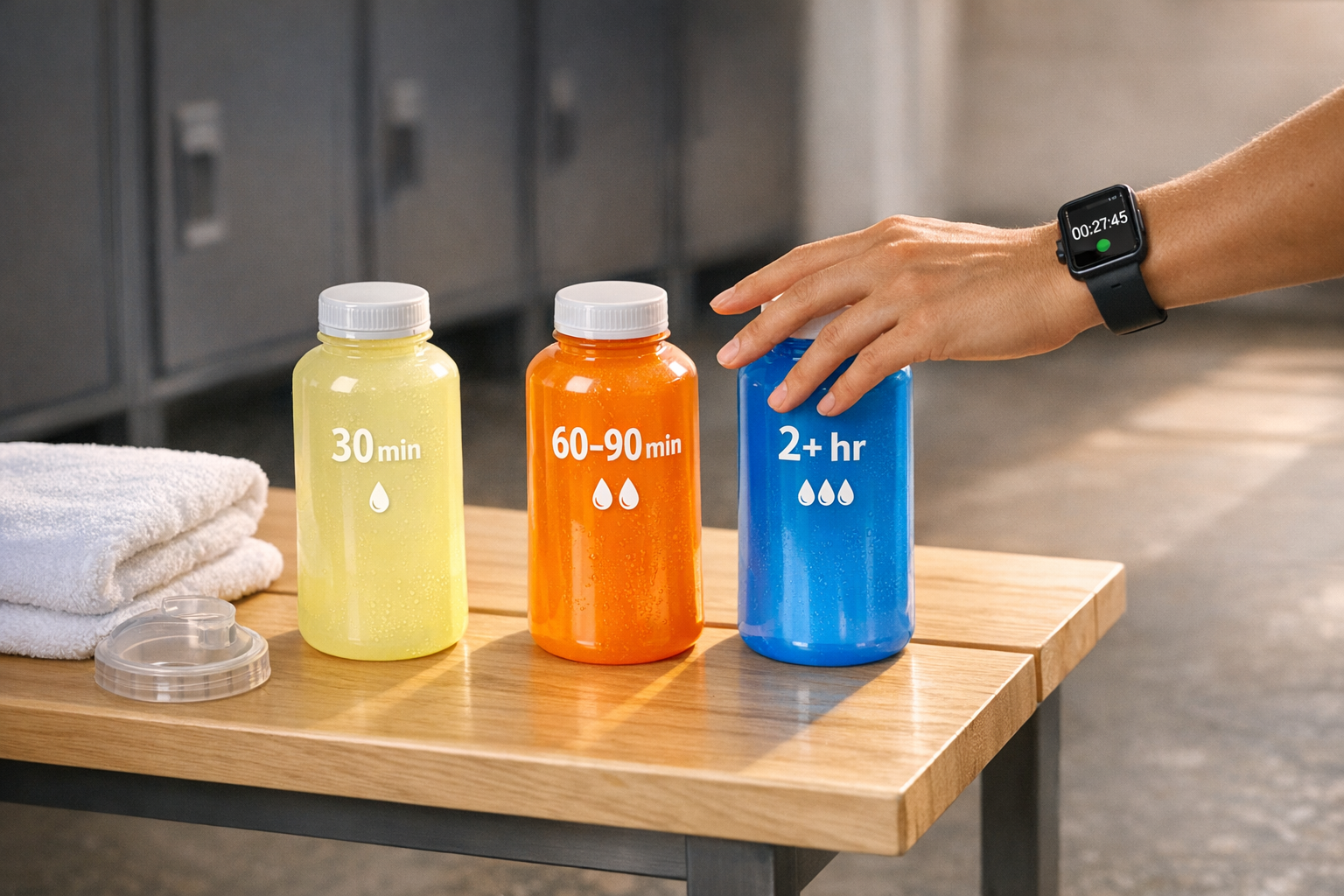
Best Electrolyte Supplements for Fitness Goals
Best Nootropics for Productivity in 2026
Top 5 Sleep Hygiene Practices for Athletes

5 Best Pre-Workouts for Pump
The 30-Minute Body That Beats the 2-Hour One
Short, high-intensity 30-minute workouts can deliver equal or better cardio, strength, and fat-loss results than long sessions.
Checklist for Choosing Clean Label Certified Supplements
Checklist to verify certifications, ingredient transparency, batch COAs, GMP compliance, and bioavailable forms in clean-label supplements.